The Hidden Reason Why Your Sciatica Keeps Coming Back — Even After the Stretches, the Massages and a New Mattress.
Pain that starts in your lower back and may shoot down your leg. Your doctor found nothing wrong. The X-ray came back clean. But something happens after midnight that no scan is built to catch — and it may be quietly undoing every stretch you did that day.
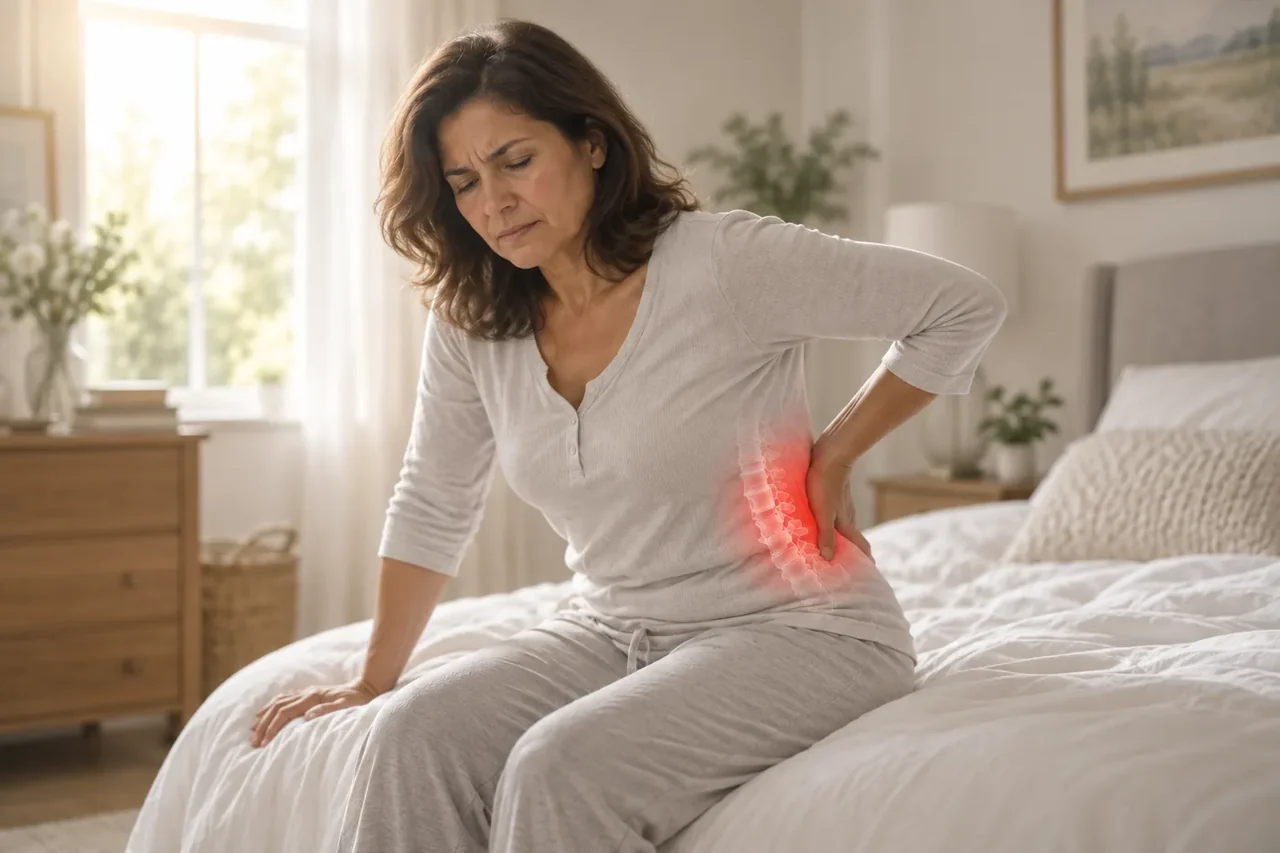
You don’t get out of bed anymore. You negotiate with it.
Eyes open. Before anything else, you run the check — how bad is your sciatica today.
One foot slides out from under the blanket and finds the floor. Then the other. One hand stays flat on the mattress, taking your weight, because you are not ready to trust your lower back yet.
You stand. And for a second you just wait there in the dark, holding still, letting the hip tell you what kind of morning this is going to be.
Then the first ten steps to the bathroom — short ones, careful ones, the walk of somebody twenty years older than you are.
By the time the coffee is ready it has loosened off. It always does. So you tell yourself it’s fine. You’re just getting older. Everyone’s back hurts.
Then night comes. And every hour you spend asleep sets the whole thing up again.
If this is your morning, you already know the pattern
Side sleepers often describe some combination of:
- Pain that starts in your lower back and may shoot down your leg
- A pulling or burning line running from the buttock down the back of one leg
- Interrupted sleep because one hip starts aching and you need to roll over
- Waking with stiffness or discomfort around the hips, knees or lower back
- Lower-back tightness that is worst during the first hour of the day
- A deep, dull ache along the outside of one hip or the top of the thigh
- Knees that feel tender after pressing against each other through the night
- Waking to find your top knee has slid forward across the mattress
Recognize two or three?
Then stop looking only at what you do while you are awake.
How much have you already spent fighting the morning after?
A firmer mattress.
Then a softer topper on top of the firmer mattress.
Stretching before bed. Heat in the morning. Massage when the hip finally screams loud enough that you stop ignoring it.
One of them quieted it down for a few hours. Maybe a day.
Then you went back to sleep — straight back into the position that caused it.
And the next morning it was waiting for you again.
Every one of those fixes starts after the damage is done. Not one of them touches the eight hours that keep doing it — so every night your body rebuilds the exact problem you paid to undo that morning.
Here is the part most side sleepers never see
The damage does not start when you stand up.
It starts the moment you stop guarding yourself.
While you are asleep.
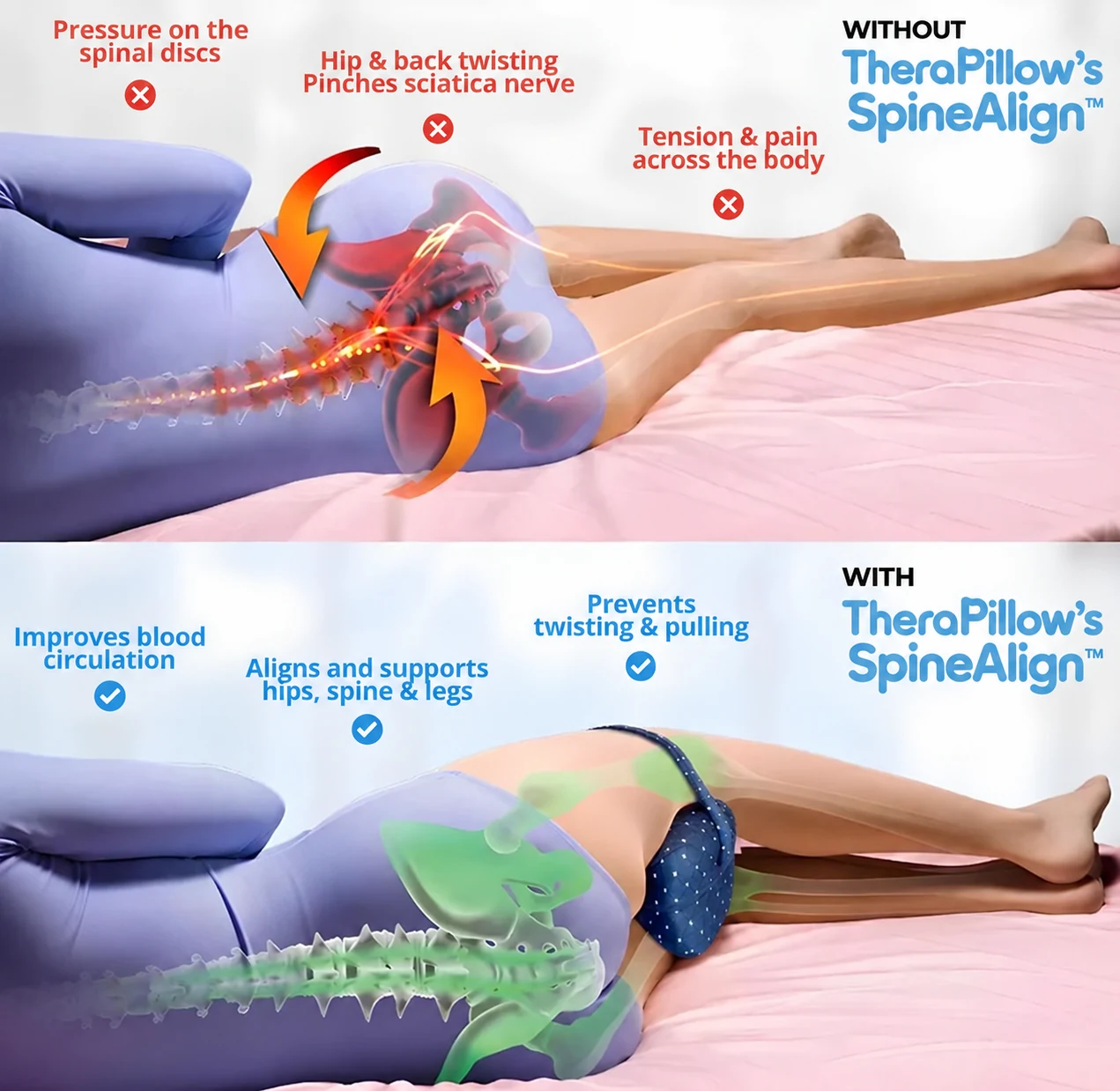
At 10pm your knees are stacked neatly and everything is fine. Then your muscles let go — and the unsupported upper leg has nothing holding it. It starts to fall.
A few centimetres down.
Then farther forward.
Your pelvis is dragged after it. Your lower back twists to absorb what the pelvis just did.
And nothing warns you. No pain sharp enough to wake you, no alarm, no signal to move — so you don’t.
You sleep straight through the position that is doing it. You wake up inside the aftermath.
So what is actually happening during those six to eight hours?
Top leg drops. Pelvis rolls. Lower back twists. Knees press together. Then the clock keeps running.
The movement is small.
What it does to you is not.
Your upper knee has nothing underneath it. Gravity drags it down and forward, and there is nothing in its way.
The pelvis is pulled over with it. It has no choice — the leg is heavier.
So your lower back takes the hit. It twists to keep your shoulders on the mattress while your hips rotate away underneath them.
Your knees are driven together and held there, bone pressed into bone, by the full weight of the leg on top.
And then nothing moves. The twist is locked in. Your body is forced to hold it.
Not for ten seconds.
For six, seven, eight hours — every single night.
Picture a wet towel being twisted hard from opposite ends
Hold one end still. Twist the other.
The middle tightens. The fibres bunch. Every extra turn drives more tension into the same narrow strip.
Now stop turning—but do not release it.
Leave it twisted for the rest of the night.
That is the visual: the upper leg falls forward, the pelvis follows, and the hip and lower back are left holding the rotation.
You may sleep through it at 3am. Your first steps at 7am are when the bill arrives.
Sound familiar?
A sore hip on waking. A lower back that needs an hour to unlock. A hot line down one leg. Tender knees. Constant side-switching. When those show up together, your sleeping position deserves a hard look.
Why this connection is so easy to miss
It is not hidden on purpose.
It is hidden by timing.
The leg drops at 3am, while you are unconscious.
The stiffness appears at 7am, hours after the position that may have contributed to it.
Nothing dramatic happens in the moment. So the mattress gets blamed. Your age gets blamed. Yesterday's activity gets blamed.
Almost nobody thinks to look at the empty space between the knees.
The University of Rochester Medical Center advises side sleepers that a firm pillow between the knees can prevent the upper leg from pulling the spine out of alignment and reduce stress on the hips and lower back. Mayo Clinic similarly recommends a pillow between the legs to help align the spine, pelvis and hips.
For some side sleepers, the missing piece is not another daytime treatment. It is support in the gap the upper leg keeps falling through.
Sources: University of Rochester Medical Center Health Encyclopedia, Good Sleeping Posture Helps Your Back; Mayo Clinic, Sleeping positions that reduce back pain.
Illustrative positioning summary, not a diagnosis or promised outcome. See a doctor about pain that is severe, worsening, or paired with numbness or weakness in a leg.
So what do your hips actually need at night?
To interrupt the position, the goal is surprisingly simple.
Your upper leg needs to stop descending.
Your pelvis needs to stay more level instead of rolling toward the mattress.
Your knees need enough separation that they are not pressing directly together.
And whatever creates that support needs to follow you when you turn.
All night.
Without you waking up to fix it.
Managing the morning after
Stretching, heat, massage and pain medicine begin after the position has already had the whole night to form.
Supporting the eight hours
Support between the legs works while the upper leg is trying to drop—not hours later when the morning stiffness arrives.
But that creates the obvious question:
How do you hold the legs in that position all night when you cannot control what they do in your sleep?
You cannot police your posture while you are asleep
You roll onto the other side.
Your upper leg shifts.
The blanket compresses.
The loose pillow stays behind.
That is where ordinary fixes fall apart. They create height at bedtime, but they do not preserve the position until morning.
A folded blanket can be flat by 4am. A spare pillow can be at the foot of the bed. A mattress cannot fill the moving gap between your thighs.
So TheraPillow™ was designed around something more important than softness:
Shape that supports the position. And a strap that keeps that shape with you.
The centre, the knee cradles and the rear support were shaped to make those four jobs work together as one system.
Not just a cushion between the knees.
A position the pillow can keep rebuilding every time you settle back onto your side.
That became:
TheraPillow™ Spine Alignment Pillow

This is not an ordinary pillow made smaller.
It is sculpted around what a side sleeper's legs actually do.
Squeeze together.
Slide forward.
Change position through the night.
TheraPillow™ cradles the knees, supports the upper thigh and stays attached to the leg when you turn.
The shape does the work you cannot consciously do while you sleep.
SpineAlign™
One uniform lump of foam gives every part of the leg the same support. SpineAlign™ does not.
It uses three connected zones, each built around a different part of the overnight collapse.
- 1Knee CradleScooped recesses seat both knees so the pillow is harder to squeeze sideways when you move.
- 2Thigh ChannelThe narrow hourglass waist keeps space between the thighs so the upper leg has somewhere to rest.
- 3Hip FloatThe taller rear lobe carries more of the upper thigh's weight, helping the pelvis rest in a more level position.

Together, the three zones support the knees, thighs and hips as one connected position.
Less twisting. More resting.
Every feature answers one brutal question: will it still be there at 4am?
- High-density contour foam maintains the space between the legs instead of collapsing flat
- Elastic thigh strap helps the pillow travel with the upper leg through normal position changes
- Sculpted hourglass profile gives both knees and thighs a stable place to rest
- Breathable quilted cover unzips for machine washing and keeps the foam protected
Thirty seconds. Three steps. Then sleep.
No posture training. No forcing yourself onto your back. No 3am alarm telling you to fix your legs.
Set it once. Lie down the way you normally do. Let the shape and strap handle the rest.
Position
Place the contoured center between your knees.
Secure
Slip the elastic strap around the upper thigh.
Sleep
Settle into your normal side-sleeping position.
What to watch for during your first 30 nights

The support feels new. Notice whether the pillow stays with you when you turn.
The three-step setup should begin to feel automatic instead of like another thing in the bed.
Compare your first ten steps with the mornings you had before you started.
Judge the pattern, not one lucky night: wake-ups, knee pressure, hip stiffness and morning movement.
Individual experiences and timelines vary. These are general patterns some customers describe, not promised outcomes. Give your body several nights to adjust before deciding how it feels for you.
The proof is not how the pillow looks. It is how the morning feels.
Real customer feedback should answer three questions: Did it stay put? Did they wake less? Did those first few steps feel different?

“It was my mornings that changed first.”
I have been a side sleeper all my life. I used to wake three or four times because one hip had started aching, then I would roll to the other side. The first two nights with TheraPillow felt different, but unlike my ordinary pillow, it did not end up on the floor. By the second week, I caught myself standing up and walking straight away—without gripping the mattress or stretching for several minutes first. It did not feel like magic. My legs simply felt better supported through the night, and I noticed the difference in the morning.
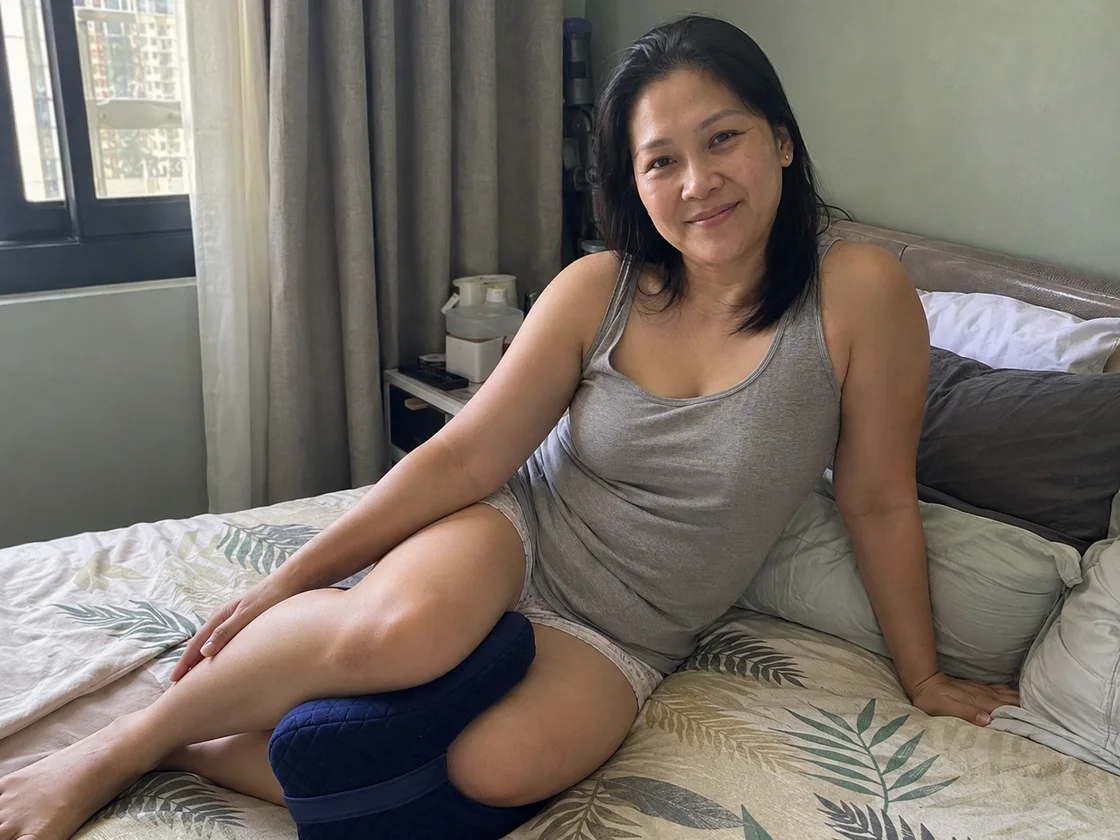
“My top knee finally has somewhere to go.”
I have tried several pillows between my knees, but they were always at the foot of the bed by morning. This one straps to my leg, so it moves with me when I turn. My legs feel steadier and my knees remain comfortably separated through the night.
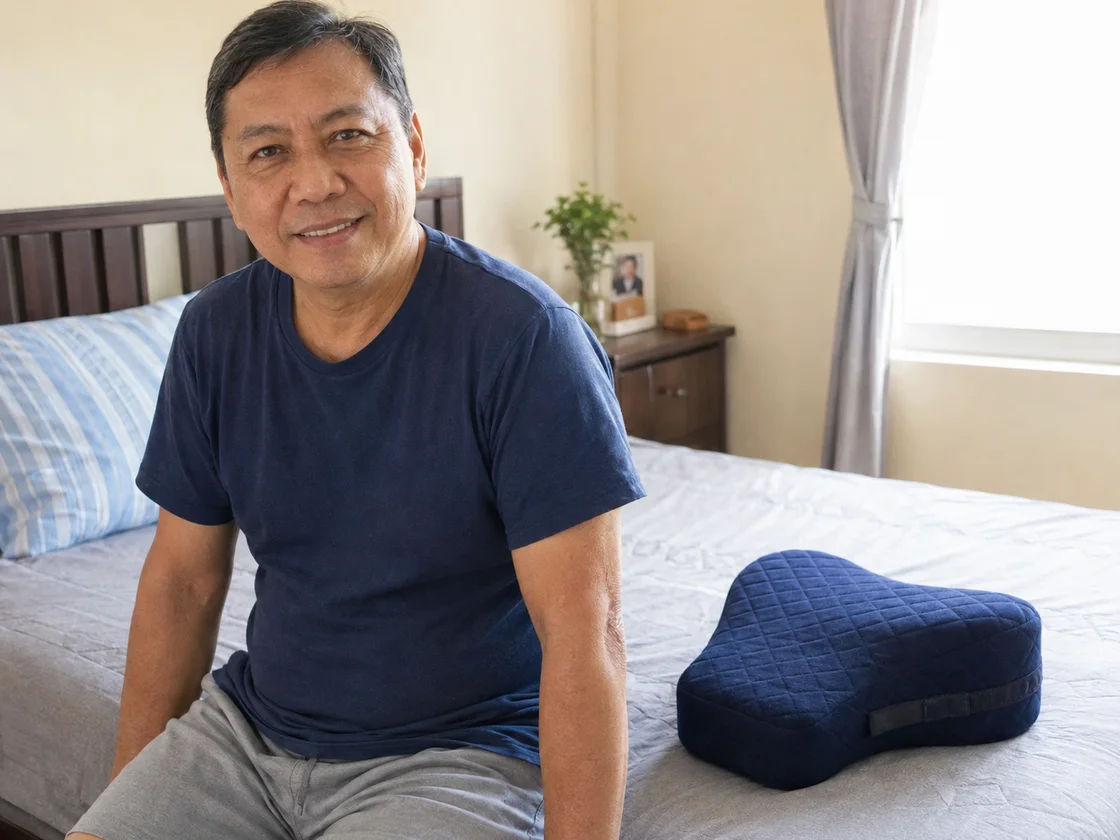
“I stopped bracing for the first ten steps.”
I assumed getting out of bed slowly was simply part of getting older. After several nights, I noticed that I no longer needed to stand and wait before walking. Those first steps toward the kitchen began to feel much more natural.
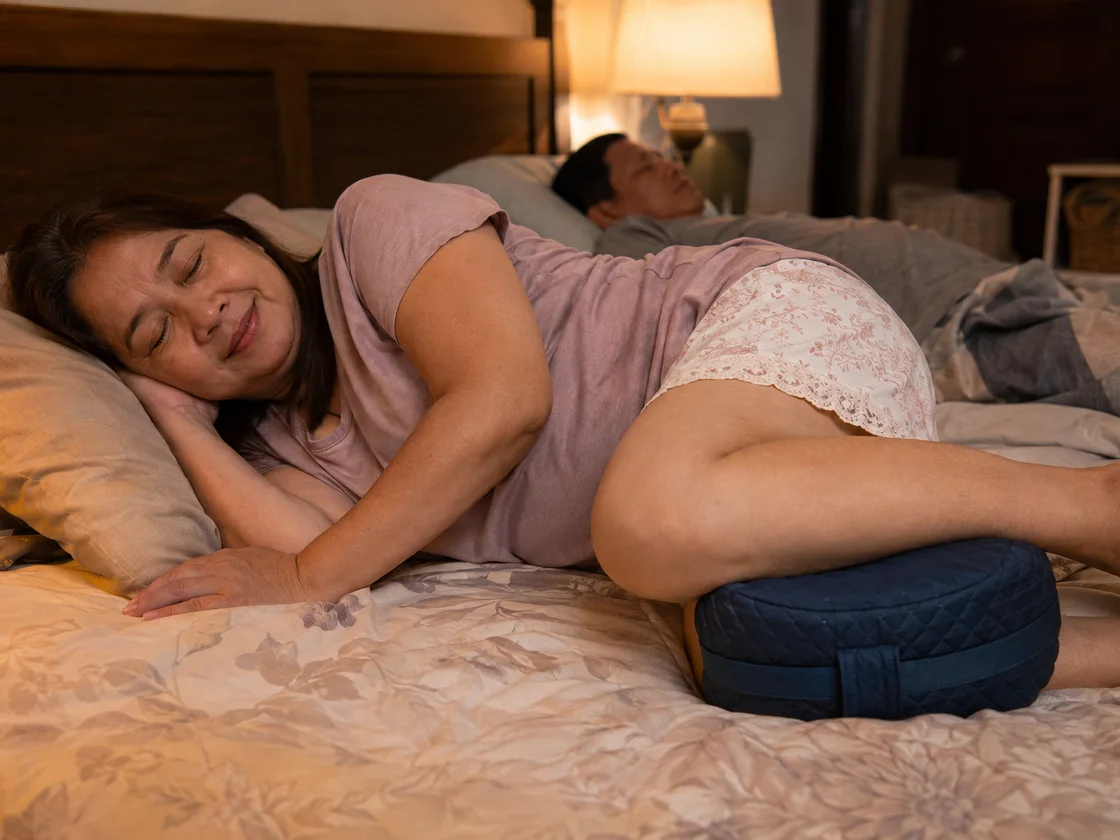
“My husband noticed the difference before I did.”
My constant turning used to wake my husband too. Now my position feels more settled, and the pillow is still there when I wake up. He says our nights finally feel quieter again.
Imagine waking up without bracing for impact
You wake up. Sit up. Stand.
No test step. No hand gripping the mattress. No mental calculation about what your hip will let you do today.
Your first thought is coffee. The school run. The walk. The work waiting for you.
Not your hip. Not your lower back. Not the first ten steps.
Before you look at the offer, consider what this may already be costing you
Another 12 sessions of physical therapy: roughly ₱9,000–₱13,000+.
Another heat pack or batch of heat patches: roughly ₱90–₱550.
Another 30 tablets for pain: roughly ₱150–₱375. Then the cost starts again when the pack is empty.
Maybe even a new mattress: ₱11,000 and up. All because the mattress must be the problem.
And the frustrating part?
Almost all of that money is spent after the night has already done its work.
TheraPillow™ was designed to support the position during the six to eight hours you are already asleep.
One pillow.
Night after night.
Approximate Philippine price examples based on publicly listed hospital, pharmacy and retailer rates; actual costs vary by provider, product and treatment plan. Use medication only as directed by its label or a qualified healthcare professional.
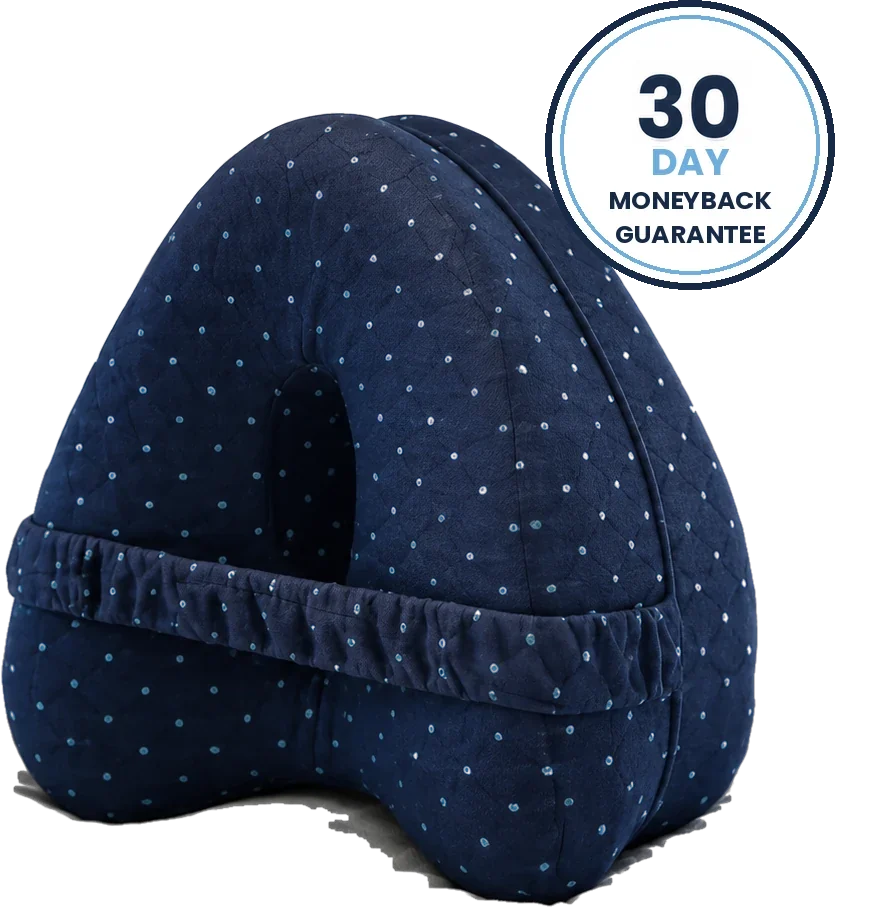
TheraPillow™ Spine Alignment Pillow
High-density contour foam · SpineAlign™ · Quilted washable cover
Built to keep the upper leg from collapsing forward, separate the knees, and stay attached through normal turns.
One pillow. Four jobs:
- A more comfortable position through the hips, knees and lower back
- Consistent separation between the knees
- Normal movement during sleep without leaving the pillow behind
- A simpler side-sleeping setup that requires no posture training
Cash on delivery · Free nationwide shipping · 30-night comfort trial
Try it for 30 nights, completely risk-free
Yes—thirty nights. Not a week, not a “trial size” version of the real thing.
And on top of that: it is Cash on Delivery. You do not pay a single peso upfront—you pay the rider when the pillow is already in your hands.
Sleep on it for 30 nights and see for yourself whether it changes your mornings.
If it works, you keep it and enjoy it every night.
If for any reason it does not, send it back. You get the full purchase price refunded under the terms confirmed at checkout.
It does not matter if you slept on it for 29 minutes or 29 nights—you only keep it if you are genuinely satisfied.
Long enough to judge it properly.
Put it through up to 30 real nights. If it is not right for you, return it during the trial period for a refund under the terms confirmed at checkout.
40% off — and the extras are still free.

The original TheraPillow™ Spine Alignment Pillow is sold only through the official Philippine offer page, and the current batch is running at 40% off.
Every bundle in this batch also ships with free extras worth ₱4,500, included only while this allocation lasts.
You may see cheaper knee pillows elsewhere. Do not confuse a similar-looking block of foam with the three SpineAlign™ zones and the strap system you have just seen.
When this batch is reserved, the discount and the free extras go with it.
Cash on delivery · Free nationwide shipping · 30-night comfort trial
The Choice That Will Define Your Next Decade

Right now, you are at a crossroads.
Path #1: Keep Doing What You Are Doing
Keep waking up with one hip feeling locked and your lower back wound tight.
Keep spending the first ten minutes testing each step, stretching beside the bed and waiting for your body to loosen.
Keep reaching for heat packs, pain medicine and another massage before the day has properly started.
Keep telling yourself, “I must have slept wrong.”
Keep avoiding the long walk. The stairs. The outing. The game with the kids. Keep rolling from one side to the other because neither hip stays comfortable for long.
Keep managing your life around a hip and lower back that should have spent the night resting.
Keep becoming a repeat customer for the massage and pain-management industries—while the unsupported position repeats untouched.
Path #2: Try Something Designed for the Actual Position
Spend less than another cycle of massages, heat products and replacement pillows.
Put support beneath the upper leg before gravity pulls it forward.
Use the SpineAlign™ zones to keep the knees separated, support a more level hip position and keep the pillow attached when you turn.
Address the overnight setup instead of only masking what you feel the next morning.
Wake up with something the old routine never gave you: a reason to expect a better-supported morning.
Stop rewarding an industry that keeps selling softness while ignoring position.
The choice seems pretty obvious to me.
Check whether the Spine Alignment Pillow is still available in your area.
See today's bundles and current Philippine availability before this production batch is allocated.
Cash on delivery, nationwide. Complete pricing and terms are shown on the next page.
30-night comfort guarantee · Free nationwide shipping
This Philippine allocation is sold by production batch
TheraPillow™ releases the Spine Alignment Pillow in controlled batches for Philippine delivery. Current allocation remaining: 12 units. When the allocation is reserved, availability pauses until the next cycle.
Editorial note. The Rest Report is an independent consumer publication. This article features a sponsored product mention and we may be compensated when readers purchase through links on this page. Content is for general information and is not a substitute for professional medical advice. The TheraPillow™ Spine Alignment Pillow is a comfort and positioning product; it is not a medical device and is not intended to diagnose, treat, cure or prevent any condition. Individual experience varies. Always consult a physician about persistent, severe or worsening pain, numbness or weakness in a leg.